The Star of Christmas pasternakiana belongs to the cycle of poems that make up part of the seventeenth novel Doctor Zhivago . It 'difficult to talk about it because if so to a certain extent it can be treated as a poem by Boris Pasternak, in reality it is meant as a work of Zhivago.
E 'was written in early 1947 and kept us Pasternak a lot. Marija Judin, which had sent, he wrote: "If you had not written anything that Christmas throughout your life, what would be for suffciente ensure immortality on earth and in heaven. " Editor Literaturnaia Moscow "which was published poetry had proposed changing the title to" Ancient masterpieces "to shift the emphasis from the religious sphere to the most innocuous of art history. Apparently this is not at all pleased to Pasternak who denied this possibility definitely. Yet even the (cowardly?) Editor had a point. The theme of Christmas in Pasternak binds to many reasons which are to be found in his great novel, but also in the autobiographical writings as the pass : Blok, childhood, Venice (as then Brodsky), but especially with the great painting, Italian - and this is well demonstrated by a test Stefano Garzonio, from which many of the news report here - but also the Dutch and Flemish.
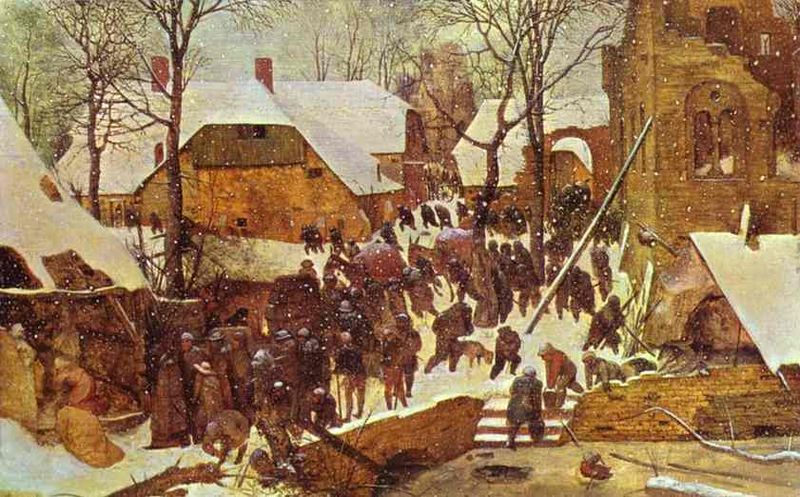
Literature Critics have noted the pictorial setting of the poem and its similarities to the picture of Hans Bruegel the Elder, The Adoration of the Magi in the snow . E 'was also observed an important difference with Brodsky for many years he also author of poems dedicated to Christmas (which he defined "vacation time connected to a particular reality, the movement of time. In the final analysis What is the feast of the Nativity? The birthday of God-made-man "). If Brodsky is closer to poetry and vision of the Nativity icon, Pasternak would guidato da una sensibilità postrinascimentale e quindi sarebbe accostabile alla pittura fiamminga con la sua secolarizzazione dell'evento sacro.
 |
| A. Savrasov |
Lo stesso Brodskij ne parlò in una sua intervista a Petr Vajl: "Penso che la fonte di questa poesia sia la stessa che la mia, la pittura italiana. Per la sua estetica questa poesia mi ricorda Mantegna o Bellini, nei quali riscontriamo continuamente cerchi, ellissoidi, archi: "Ogrady, nadgrob'ja, ogloblja v sugrobe/ i nebo nad kladbišče, polnoe zvezd" – sentiteli in tutte quelle 'o', 'a', ob'. Se si vuole paragonare con la nostra estetica russa, naturalmente qui si tratta dell'icona. Aureole che si creano e che si dilatano. Nella poesia di Natale di Pasternak ci sono molte cose: la pittura italiana, Bruegel, dei cani che corrono ecc. ecc. C'è già il paesaggio dell'oltremoscova. Spunta Savrasov. /.../ A questo proposito, non ha senso entrare in polemica, io ho anche qualche obiezione sul modo con cui Pasternak ha trattato questo soggetto, in particolare nella Stella di Natale. /.../ In lui ad agire è la forza centrifuga. I raggi si dilatano continuamente dalla figura centrale, dal Bambino. Quando invece in realtà sarebbe tutto il contrario."
Come osserva Garzonio (è lui che cita l'intervista a Brodskij) è questo che ha fatto sì che Pasternak fosse considerato "narrativo", disperso nei dettagli, mentre Brodskij (in una poesia del 1987 dal medesimo titolo) più rigorosamente "iconologico", concentrato su di un punto, sull'essenziale.
Andiamo a vedere allora il nucleo da cui sgorga La stella di Natale all'interno del romanzo. Nel capitolo X capitolo della III parte, il giovane Živago andando alla festa di Natale degli Sventickie pensa:
"... ardeva dolcemente la vita natalizia di Mosca, scintillavano gli alberi, si affollavano gli invitati e gente in maschera giocava a rimpiattino, dimentica di tutto.
Ad un tratto Jura capì che Blok era la manifestazione del Natale in tutte le sfere della vita russa, nella vita quotidiana della città del Nord e nella letteratura contemporanea, sotto il cielo stellato della strada di oggi e intorno all'albero illuminato nel salone del secolo attuale. Pensò che non occorreva alcun articolo su Blok, ma bisognava semplicemente dipingere un'adorazione dei Magi russa, come quelle degli olandesi con il gelo, i lupi e una cupa foresta di abeti."
Ecco quello che mi preme. Non trovo che il carattere fiammingo di Pasternak sia una secolarizzazione del sacro, ma uno sguardo, tipico di tutto his great novel, which combines the sacred and the profane. Christmas "in all spheres of Russian life." The contemplation of the Nativity through newspapers and more concrete details, the scene of preepe merges with the landscape glimpsed through the window of Peredelkino, the poet's house. Angels are mixed with the crowd, invisible, but the footprints are imprinted in the snow with those of the men who accompany them. The straws, dogs that go up and down, do not disturb the look together and not disperse annihilating with centrifugal force. Instead, they combine into a coherent whole earth and sky. The star is not confined to shine at the top. This is so luminous that, however, knows how to burn a haystack on fire land, on the threshold of the hut was a guest.
images via Wikipedia


0 comments:
Post a Comment