 |
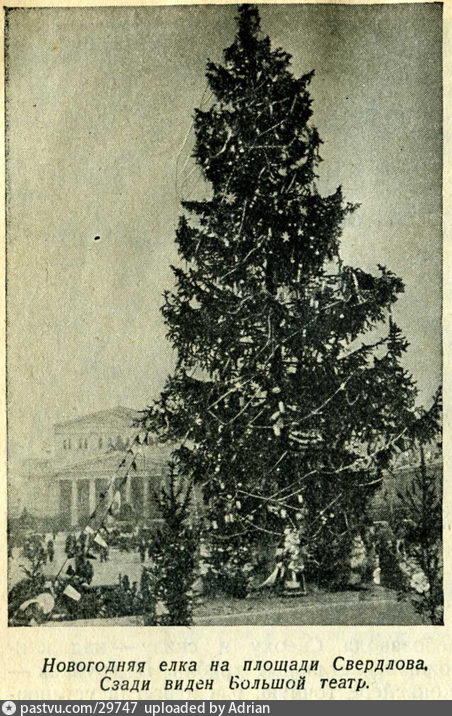
| The tree in the center of Moscow in 1937 probably |
To better understand the atmosphere that enveloped Pasternak, Zhivago or better, to work on Poinsettia , worth listening Yevgeny Pasternak (the son of Boris) who writes in his memoirs: "In that year [1929 ] came with an official decree banned the celebrations for New Year and Christmas. They were banned Christmas trees . They had been branded as remnants of religious objects and made a strong ostracism. He was also prohibited the ringing of bells. Mosca was suddenly immersed in the frightening sound of silence, the more heartbreaking because Dad was very fond of the festive season which took him back to since childhood. The churches began to be closed in mass and the bells were removed. " (EB Pasternak, Ponjatoe the obretennoe [What I have understood and made my] Tri kvadrata, Moskva 2009, c. 364.
The history of the bells will prick up their ears to all the fans tarkovskijani. But that's not why I want to talk.
The tradition of the Christmas tree had become widespread in Russia at the popular level in the early twentieth century. With the advent of the Bolsheviks and the adoption of the new timetable (24 January 1928) Gregorian (until then, Russia followed the Julian date, remained in use for the Orthodox churches) all dates were shifted by 13 days and it happened for the Christmas holidays. The new Soviet authorities left in the first time all the same and so until 25 December 1929 was a day holiday, especially in the repute of the NEP period. In December 1923, for example, even the estate Gorki, where Lenin was already mortally ill, he was made a beautiful Christmas tree.
As recalled by E. Pasternak, however, came in January 1929 issued a decree entitled "On measures for the intensification of anti-religious work." In the year of "great breakthrough" (Velikiy perelom ) was adopted, inter alia, " nepreryvka "(lit." without interruption "), built before a week over 5 days, 4 and a working holiday, then 6, 5 +1, where the holidays were fluid, other than each other, producing did not stop mai. Le famiglie e gli amici non si incontravano più. Alla fine, di fronte al disagio generale, vennero stabiliti giorni festivi fissi. Non la domenica, ma il 6, il 12, 18, 24 e 30 di ogni mese. Per tutti gli anni Trenta continuarono gli esperimenti finché nel 1940 con uno speciale ukaz del Presidio del Sovet Supremo si ripristinò la normale settimana di 48 ore lavorative con la domenica festiva. (La storia di ripete? Lo statalismo sovietico staliniano viene a toccarsi con il liberismo sfrenato dei nostri giorni? La smania di vendere-comprare 24 ore su 24 7 giorni su 7?)
L'albero di Natale ebbe più o meno lo stesso destino. Era proibito e nella prima metà degli anni Trenta they unleashed the writers and publications for children because writing works anti-Christmas tree. Dangerous anti-revolutionary legacy, of course. A. Vvedenskij on "CIZ" he wrote in 1931: "Только тот, кто друг попов / Елку праздновать готов" (Only the priest who is a friend / It 's ready to celebrate with the tree). Kindergartens and schools who did were fined. Even enthusiasts of the Komsomol had permission to monitor the private apartments.
did not last long, fir needles full of fragrant and promises bright was rehabilitated in 1935, when it appeared in Pravda article of the Secretary of the Central Committee of the Communist Party of Ukraine, P. Postyšev, who urged: "We organize a beautiful tree for our children." Children Soviets were not to be deprived of this joy and in each school within the Komsomol, cinema, etc., should have been a nice dress (Elka). Knocked out the Christmas tree was associated with the New Year, even if January 1 was declared a public holiday in 1947.
The image is taken from the forum http://oldmos.ru/


0 comments:
Post a Comment